
If you’ve ever requested a silver nitrate price in India and received three different figures from three different suppliers, you’re not alone — and you’re not dealing with a pricing mystery. You’re dealing with a product where the cost is genuinely built from several moving parts, and most suppliers don’t explain them.
That lack of transparency makes procurement harder than it needs to be. You’re expected to compare quotes without knowing whether you’re comparing the same grade, the same documentation standard, the same packaging, or even the same silver content. Place an order based on the lowest number and you may save on the invoice — but if the batch is inconsistent, the real cost shows up on your production floor.
Pheonix Industries has been manufacturing silver nitrate in Ahmedabad since 2006. We supply electroplating units, pharmaceutical manufacturers, chemical processing companies, and analytical laboratories across India. This article lays out exactly what goes into the cost of AgNO3 — so you can read a supplier’s quote and know what you’re actually looking at.
Why Silver Nitrate Prices Vary Between Suppliers in India
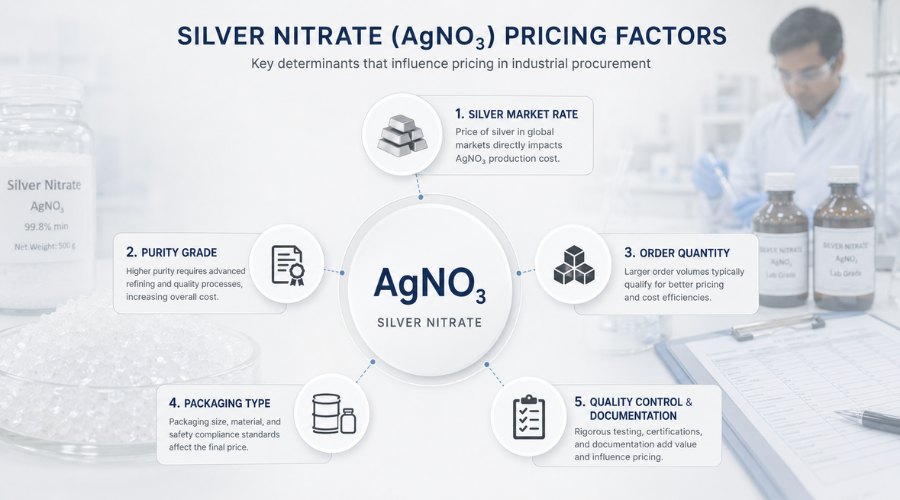
Silver nitrate is not a commodity where all suppliers are selling the same thing at slightly different margins. Every rupee in the silver nitrate cost can be traced back to something specific — the raw silver input, the purity grade, the manufacturing process, the documentation, or the packaging. When two quotes look different, they almost always reflect different decisions on at least one of these.
Silver is a precious metal traded on global commodity markets, and it makes up roughly 63% of silver nitrate by molecular weight. That means the price of silver on any given day is embedded directly in every kilogram of AgNO3 you buy. A quote from last month may not be valid today — not because the supplier changed their margin, but because the silver rate moved.
This is why the silver nitrate price per kg in India can’t be listed as a single figure that stays accurate. The right way to evaluate it is to understand the components — and to recognise that a supplier quoting significantly below market is almost certainly saving money somewhere you’d rather they didn’t.
Why Choosing on Price Alone Creates Problems Downstream
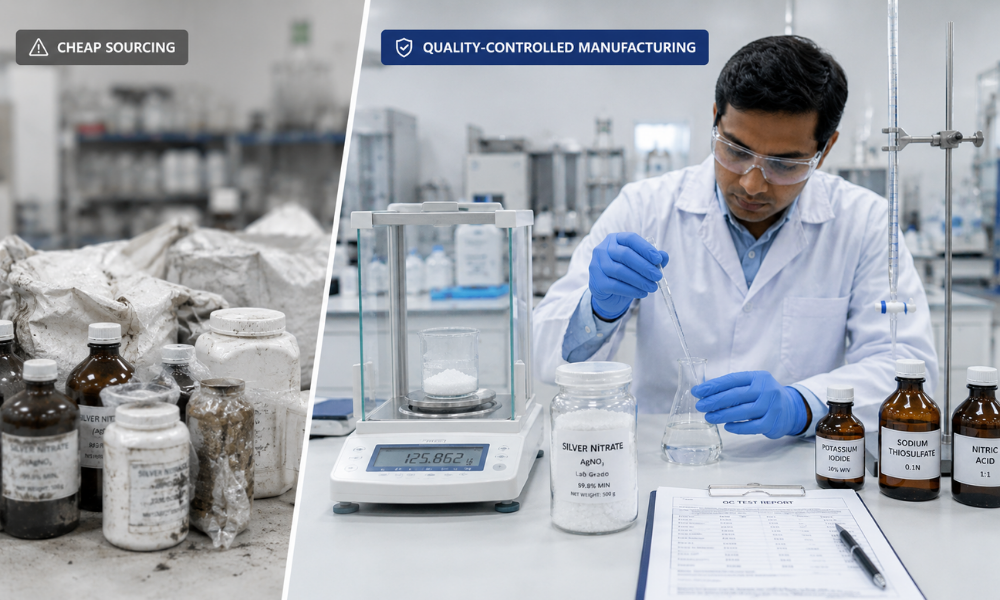
There’s genuine pressure on procurement teams to bring input costs down. That pressure is legitimate. But silver nitrate is one of those materials where the per-kg saving on a cheaper source can quietly cost you several times more once it reaches your process.
Here’s what typically happens: a buyer finds a supplier offering silver nitrate at a lower price per kg. The documentation looks acceptable, purity is confirmed verbally or on a generic spec sheet, and the order goes through. The first batch is fine — or at least nothing fails obviously. The second batch performs differently. The third triggers a quality incident. By the time the investigation concludes, the input material is the cause — and the root problem is batch-to-batch inconsistency that the supplier had no mechanism to detect or prevent.
Lower silver nitrate prices almost always reflect one or more of these realities: purity slightly below the stated grade, no in-house testing with the batch you specifically receive, inadequate packaging that allows light or moisture ingress in transit, or supply through a trader who sourced from whoever was cheapest that month. None of these show up on the invoice. They show up in your process.
The hidden costs are straightforward to calculate in hindsight: wasted production runs, rejected output, rework labour, re-testing time, and the disruption of emergency re-sourcing. A manufacturer who can trace any issue to a specific batch and provide documentation is worth a meaningful premium over one who cannot. We say this not to pitch ourselves — it’s simply how the economics of this material work.
Key Factors That Affect Silver Nitrate Price Per Kg in India
Purity and Grade Specifications
Silver nitrate comes in several grades: AR (Analytical Reagent), LR (Laboratory Reagent), ACS grade, and industrial grade. Each has a different purity ceiling and a different price point — and the difference between grades is not cosmetic.
Industrial-grade silver nitrate is typically 99.5% pure and is appropriate for electroplating, mirror production, and general chemical synthesis. AR and ACS grades — which Pheonix Industries supplies at 99.9% purity — are required where trace impurities would affect outcomes: pharmaceutical intermediates, analytical testing, and precision chemical applications.
Higher grades cost more because they require tighter manufacturing controls, more rigorous testing, and comprehensive documentation per batch. If a supplier offers pharmaceutical-grade AgNO3 at the same price as industrial grade, treat it as a warning, not a deal.
Live Silver Market Rates
Silver (Ag) makes up approximately 63% of silver nitrate by molecular weight, which means the global silver commodity price is the dominant cost input for every kilogram manufactured. Silver trades daily and moves based on USD exchange rates, industrial demand cycles, investment flows, and broader commodity market conditions.
This is why serious manufacturers price silver nitrate with reference to the prevailing silver rate at the time of enquiry. It’s also why annual fixed-price contracts for silver nitrate are uncommon — the input cost isn’t fixed. When comparing quotes received at different times, you may be comparing different market conditions, not different supplier margins.
Order Quantity and Bulk Pricing
Manufacturing economics mean that per-unit cost falls as order volume rises. For silver nitrate, this effect is more pronounced than for many other chemicals because batch setup, quality testing, documentation, and logistics carry largely fixed costs whether you’re ordering 1 kg or 500 kg.
Small laboratory quantities — silver nitrate 100g packs or silver nitrate 25 gm containers — carry the highest price per gram. This isn’t a margin decision; it reflects the genuine overhead of weighing, individually packaging, testing, and documenting small volumes to the same quality standard as bulk orders.
Bulk industrial procurement brings meaningful per-kg savings, and structured repeat arrangements with a direct manufacturer tend to be even more efficient — you get predictable pricing, planned production, and consistent supply without the disruption of spot-order pricing.
Packaging and Safe Handling
Silver nitrate is light-sensitive and classified as an oxidiser. Exposure to light during storage or transit causes slow decomposition — meaning the product that arrives may not perform to the specification you ordered. Proper packaging isn’t optional; it’s part of the product.
Correct packaging means amber glass bottles or dark HDPE containers with proper seals, hazard labelling, and where applicable, UN-compliant transport packaging. All of this adds to the cost. Suppliers significantly undercutting on price while using inadequate packaging are either absorbing the loss from somewhere else in the product or compromising its integrity before it reaches you.
Manufacturing Standards and Quality Control
In-house manufacturing with documented quality control costs more than repackaging and reselling. But it’s the difference between a consistent product and an unpredictable one.
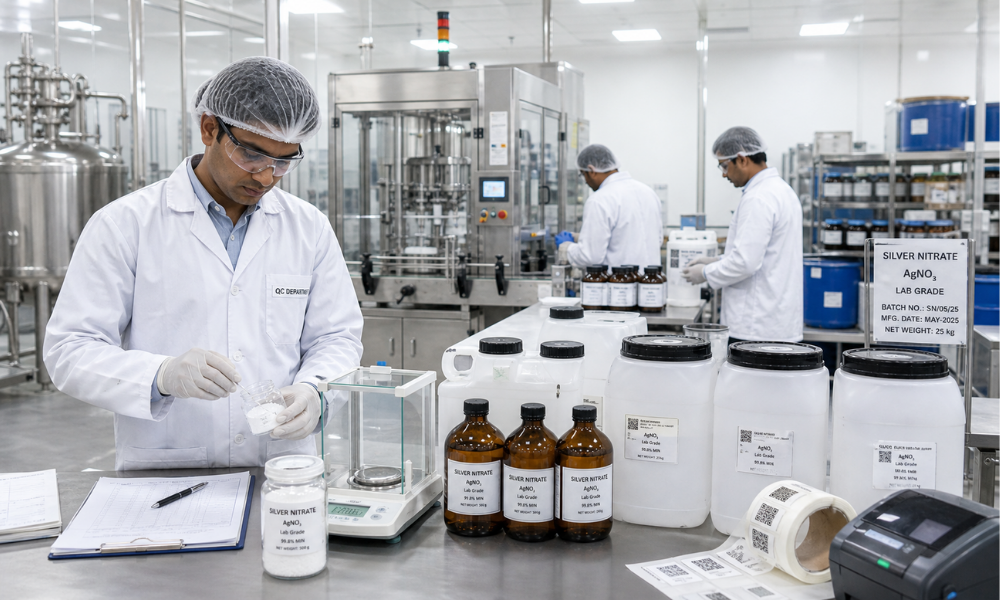
At Pheonix Industries, every batch of silver nitrate goes through multi-stage testing — titration and gravimetric analysis — before it leaves the facility. A Certificate of Analysis is issued for each specific batch, not generated from a template. This testing infrastructure is a real operational cost. It’s also what makes it possible for us to trace and respond to any quality query with actual data from the specific batch you received.
A supplier without this infrastructure will always quote lower. The question worth asking is: what exactly are you not paying for?
Indicative Pricing Structure — Silver Nitrate in India
Silver nitrate pricing moves with the live silver commodity rate and the specific grade being supplied, so published fixed prices go out of date quickly. What we can share is the relative pricing structure — how different quantity tiers, grades, and pack formats compare to each other.
Use this as a framework for budgeting and supplier evaluation, not as a quote. Contact Pheonix Industries for a current price based on your specific grade and volume requirements.
| Pack Size / Order Tier | Typical Buyer | Relative Cost Per Gram | Pricing Note |
| Silver Nitrate 25g – 100g | R&D labs, academic institutions | Highest | Individual packing, testing, and documentation per unit adds significant overhead |
| 100g – 500g | Smaller labs, specialty applications | High | Still in small-batch territory; per-gram overhead remains elevated |
| 500g – 5 kg | Mid-scale labs, smaller industrial users | Moderate | Where bulk economics begin. Meaningful reduction vs small pack pricing |
| 5 kg – 25 kg | Industrial buyers, electroplating, pharma | Lower | Significant per-kg saving vs small quantities. Standard industrial procurement tier |
| 25 kg+ / Bulk / Repeat Orders | Large manufacturers, ongoing supply contracts | Most Competitive | Best per-kg rate. Supply planning and scheduling benefits also apply at this tier |
| AR / ACS Grade (any quantity) | Pharma, analytical, regulated applications | Premium over industrial grade | Higher purity = stricter QC = additional testing and documentation cost |
Note: Silver nitrate prices in India are indexed to the global silver rate. All indicative pricing above assumes prevailing silver market conditions at the time of enquiry. Contact us with your grade, quantity, and delivery requirements for a current, specific quote.
How to Evaluate a Silver Nitrate Quote — Beyond the Per-Kg Number
A competitive quote is worth pursuing. But for a material that feeds directly into your manufacturing process, the per-kg figure is the beginning of the evaluation, not the end of it.
Before confirming any order, these are the questions that will tell you whether you’re looking at a genuine cost saving or a deferred problem:
- Does the supplier provide a batch-specific Certificate of Analysis — not a generic spec sheet, but test results for the exact batch you’ll receive?
- Are they a manufacturer or a trader? If they’re a trader, can they tell you who manufactures the product and what quality controls that manufacturer uses?
- How was purity verified? Titration and gravimetric analysis are the standard methods for silver nitrate. A supplier who cannot answer this question is telling you something.
- How is it packaged? Light-sensitive oxidisers shipped in inadequate containers may have already begun to degrade before arrival.
- Can they supply consistently at your volume, not just on the first order?
- What documentation comes with each shipment — COA, MSDS, batch traceability?
The distinction between a cheap input and a cost-effective one is measurable in a manufacturing environment. A cheap material that performs inconsistently generates rework costs, QC overhead, and production disruption. A cost-effective material performs to specification every batch, reduces incoming testing burden, and doesn’t generate surprises. These two inputs are not the same, even when one has a lower number on the invoice.
If you want to check whether Pheonix Industries’ pricing fits your budget before going through a formal evaluation process, just ask us. We’d rather give you a straight answer early than waste your time or ours.
Why Industrial Buyers Choose Pheonix Industries
The straightforward version: we’re a manufacturer, not a trader. That means when you buy from us, you’re buying from the facility where the product was made. We have direct control over the manufacturing process, the testing, and the documentation — which means we can stand behind every batch in a way that intermediaries cannot.
Every shipment of silver nitrate from Pheonix Industries comes with a batch-specific Certificate of Analysis, MSDS, and full traceability documentation. If your QC team raises a question about a batch, we can respond with the actual test data from that specific production run — because it exists, and because we conducted it ourselves.
On pricing, we’re transparent: our prices are calculated against the prevailing silver rate and the grade being supplied. We don’t offer artificially low opening prices and recoup through quality compromises on subsequent orders. Buyers who have worked with us for a while will tell you that what makes the relationship work is the predictability — consistent product, reliable timelines, and documentation that makes their own compliance process easier.
We supply silver nitrate in industrial grade, AR, LR, and ACS grades to electroplating and metal finishing operations, pharmaceutical intermediates manufacturers, analytical and research laboratories, chemical processing units, and mirror and specialty coating producers across India. Whatever your application, we manufacture to the grade your process requires — not to a single generic standard that may or may not suit your needs.
If you’re currently evaluating suppliers, we’re happy to answer technical questions, provide a sample with COA, or give you a quote against your specific volume and grade requirements. No sales pressure — just a straight conversation about whether we’re the right fit.
What Working with a Direct Manufacturer Actually Changes
The operational difference between sourcing from a manufacturer versus a trader is real, and it shows up in measurable ways over time.
- Batch consistency means your process parameters stay stable. You’re not constantly adjusting to compensate for variable input quality.
- Complete documentation per shipment reduces incoming QC time and supports your own compliance requirements without additional work on your end.
- Technical support from people who understand the manufacturing process — when you have a question about grade selection, storage, or application-specific requirements, you get an informed answer, not a redirect.
- Supply reliability without intermediary risk — no stock-outs because a trader’s supplier ran short, no grade substitutions without notice, no delays from a broken chain you weren’t part of.
- Lower total cost of procurement over time — even when the per-kg silver nitrate price from a manufacturer is not the absolute lowest figure available.
These are not abstract promises. They translate into lower rejection rates, more predictable production scheduling, reduced raw material testing overhead, and a procurement relationship that genuinely reduces your workload rather than adding to it. Most of our long-term customers started with a single order to verify what we were saying — and found that it matched.
Frequently Asked Questions About Silver Nitrate Price in India
Q. What is the silver nitrate price per kg in India?
Ans. Silver nitrate price per kg in India moves with the global silver commodity rate, which changes daily, and varies by grade, packaging, and quantity. For an accurate current figure, contact a manufacturer directly with your specific grade and volume. Refer to the indicative pricing structure above for relative cost comparisons across quantity tiers.
Q. Why is silver nitrate so expensive compared to other industrial chemicals?
Ans. Silver (Ag) makes up approximately 63% of silver nitrate by molecular weight. Silver is a globally traded precious metal, and its market price is embedded in every kilogram of AgNO3. That’s why silver nitrate is costly relative to most other inorganic industrial chemicals — it’s carrying the price of a precious metal, not just a synthesis cost.
Q. What factors affect AgNO3 pricing?
Ans. The main factors are: live silver market rates, purity grade (industrial vs laboratory vs pharmaceutical), order quantity, packaging requirements (amber glass or HDPE for a light-sensitive oxidiser), manufacturing quality and documentation overhead, and logistics. Each of these contributes a real, traceable cost to the final per-kg price of AgNO3.
Q. Does purity grade affect silver nitrate cost?
Ans. Yes, significantly. Higher purity grades — 99.9% AR or ACS grade — require stricter manufacturing controls, more rigorous testing, and full analytical documentation per batch. Industrial grade at 99.5% purity is less expensive. Match the grade to your application: over-specifying wastes budget, under-specifying creates process and compliance risk.
Q. What is the price of silver nitrate 100 g, typically used for?
Ans. Silver nitrate in 100g packs is primarily used by laboratories, research institutions, and educational facilities where small, precisely weighed quantities are needed for analytical work. Industrial buyers typically procure in kilograms or multi-kilogram quantities. The price per gram in 100g packaging is considerably higher than per-kg bulk pricing due to individual packing, handling, and documentation costs.
Q. Can silver nitrate be purchased in bulk quantities?
Ans. Yes. Pheonix Industries supplies silver nitrate in bulk quantities to industrial buyers across the electroplating, pharmaceutical, chemical manufacturing, and laboratory sectors. Bulk pricing is structured and significantly more cost-efficient per kilogram than small quantity orders. Supply arrangements can be tailored to your production schedule and volume requirements.
Q. How should I choose a silver nitrate supplier in India?
Ans. Prioritise manufacturers over traders. Ask for batch-specific COA documentation. Confirm the test method used to verify purity — titration and gravimetric analysis are standard. Check that the packaging is appropriate for a light-sensitive, oxidising chemical. Ask about their consistent supply capacity for your volume. Price should be one factor in the evaluation, not the only one.
Q. Why do silver nitrate prices vary so much between suppliers?
Ans. Variation reflects differences in grade, purity specification, manufacturing quality, documentation overhead, packaging standards, and whether the supplier is a manufacturer or a trading intermediary. Quotes obtained at different times also reflect different silver market conditions. Two quotes for the same grade, at the same time, from a manufacturer and a trader will differ, and the difference tells you something important about what you’re buying.
Getting Silver Nitrate Procurement Right
Silver nitrate pricing becomes straightforward once you understand its components. The silver content, the grade, the manufacturing quality, the packaging, and the documentation are all part of what you’re paying for. When you evaluate suppliers purely on per-kg price, you’re comparing numbers that may have very different realities behind them.
The buyers who get the most consistent value out of their silver nitrate procurement are the ones who look at the full picture: batch-specific COA, supplier manufacturing credibility, supply reliability, technical support capability, and pricing that makes sense given current silver rates. That’s not a complicated checklist — it’s a straightforward way to avoid the problems that come from choosing purely on price.
If you’re in the process of evaluating suppliers, or if you’re dealing with a consistency problem from your current source and want to understand your options, talk to us. We’ll give you clear, technical answers and a current quote based on what you actually need — not a sales pitch.
Partner with Pheonix Industries
High-purity silver nitrate. Transparent, grade-indexed pricing. Dependable bulk supply built for industrial performance.
Request Latest Pricing | Get Bulk Quote | Talk to Technical Team
sales@pheonixindustries.com | +91-9824095459/60 | www.pheonixindustries.com