
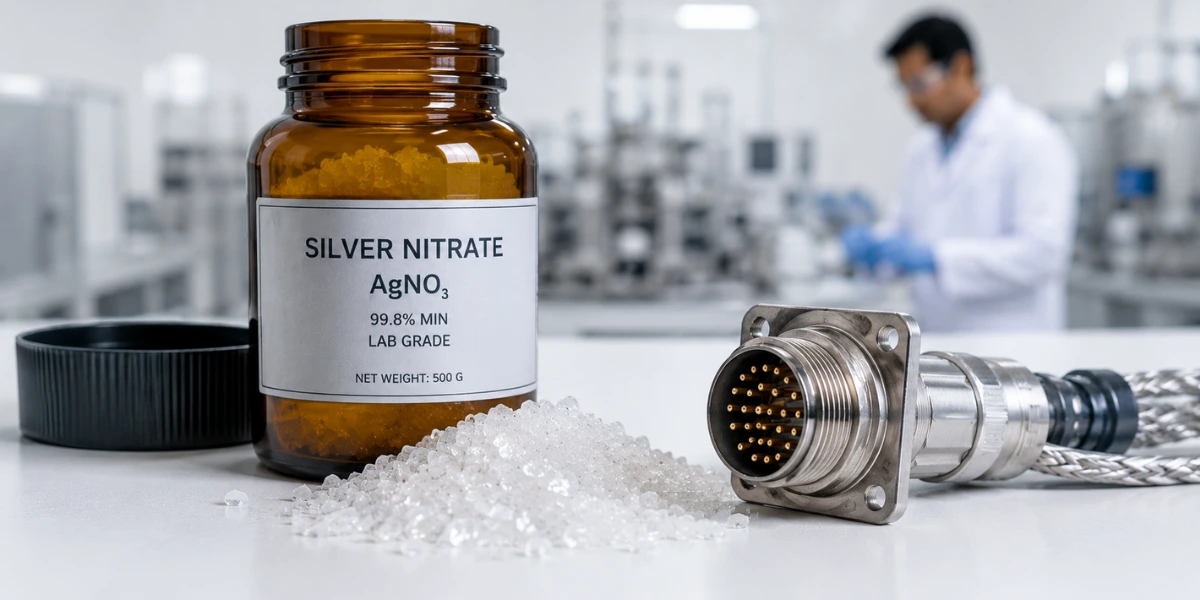
If your silver plating operation is producing inconsistent deposits — uneven thickness, dull finish, poor adhesion, or unexplained bath degradation — the quality of your silver nitrate input is worth examining before you look anywhere else.
Silver nitrate (AgNO3) is the primary silver ion source in most cyanide-free plating baths and the starting compound for silver cyanide used in cyanide-based systems. The grade and purity of the silver nitrate you use determines the quality of silver ions available in the bath, the presence or absence of contaminants that interfere with deposition, and ultimately the consistency of the finish you deliver.
Most electroplating operations in India source silver nitrate without much scrutiny of the grade — the purchase decision comes down to price and availability. That approach works until it doesn’t. When a batch performs differently, tracing the root cause back to the input material can take days and cost significantly more than the difference in price between a properly specified input and a cheaper one.
Pheonix Industries has been manufacturing silver nitrate in Ahmedabad since 2006, supplying electroplating units, electronics manufacturers, and metal finishing operations across India. This article covers what you actually need to know about silver nitrate for electroplating — not a chemistry textbook overview, but the practical information that affects your process and your output quality.
What Silver Nitrate Actually Does in a Plating Bath
In a silver plating bath, silver nitrate dissolves completely in water and dissociates into silver ions (Ag+) and nitrate ions (NO3-). The silver ions are what get reduced at the cathode — your workpiece — to form the deposited silver layer.
In cyanide-free systems, silver nitrate is often used directly as the silver ion source, typically at concentrations between 25–50 g/L depending on the bath formulation, current density, and the finish required. In cyanide-based systems — still the industrial standard for most bright silver plating — silver nitrate is used to prepare silver cyanide (AgCN), which then forms the silver-cyanide complex in the bath.
What matters in both cases is what else comes in with the silver nitrate. Impurities don’t disappear when the compound dissolves — they become part of your bath chemistry. Some build up over time. Some react immediately. Some only show their effects after several plating cycles when their concentration crosses a threshold your bath can no longer tolerate.
How Impurities in Silver Nitrate Affect Your Plating Results
Chloride Contamination
Chloride is the most immediately problematic impurity in silver nitrate for electroplating. Silver ions react with chloride to form silver chloride (AgCl), which precipitates out of solution. This precipitate can deposit with the silver layer, creating porosity in the plating — small voids in the deposit that reduce conductivity, adhesion, and corrosion resistance.
A silver nitrate with chloride content above acceptable limits will begin degrading your bath chemistry from the first addition. For sensitive applications — electronic connectors, circuit board components, precision instruments — even trace-level chloride contamination is unacceptable. For general decorative plating, higher chloride tolerance exists, but the cumulative bath effects of repeated contamination are real.
Copper and Heavy Metal Traces
Copper is present as a trace impurity in lower-grade silver nitrate. In a plating bath, copper ions compete with silver ions for reduction at the cathode. The result is co-deposition — copper deposits alongside silver, affecting the colour, conductivity, and surface hardness of the plated layer. For electronics applications where conductivity is the primary function of the silver coating, even small amounts of co-deposited copper change the material properties of the deposit.
Other heavy metal traces — iron, lead — can cause similar effects depending on concentration and the specific bath formulation. Their impact accumulates over bath life.
Moisture and Storage Degradation
Silver nitrate is hygroscopic and light-sensitive. Material that has been stored in inadequate packaging — non-sealed, light-permeable containers — undergoes partial photodecomposition before it reaches your bath. The decomposition products include colloidal silver and nitrogen dioxide. Neither is a problem in small amounts, but if you’re starting every bath preparation with already-degraded material, you’re working against yourself from the beginning.
This is why the packaging of the silver nitrate you buy matters as much as the specification on the label. A correctly specified product in inadequate packaging may not match its stated purity by the time it reaches you.
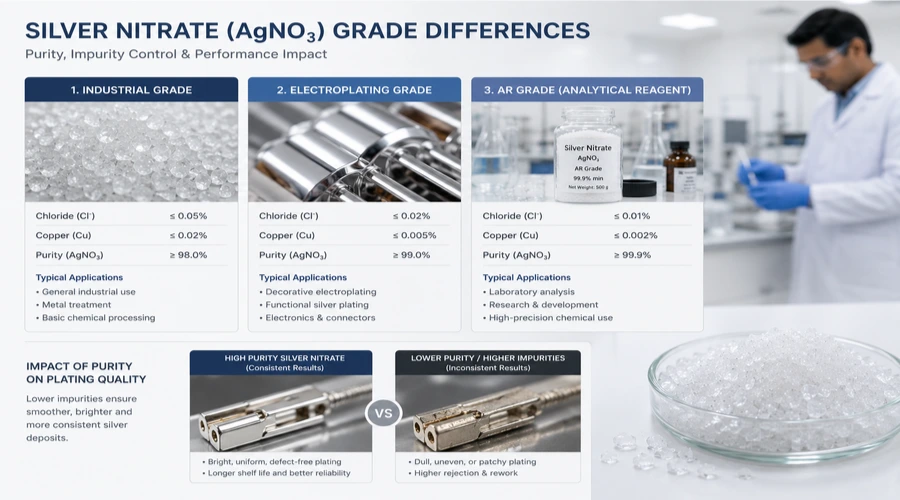
Which Grade of Silver Nitrate Does Your Operation Actually Need?
The honest answer is: it depends on what you’re plating and what standard the finished part needs to meet. There is no single correct answer for all electroplating operations.
Industrial Grade Silver Nitrate (99%–99.5% purity)
Suitable for general decorative silver plating where aesthetic finish is the primary requirement and tight conductivity or surface property specifications don’t apply. Lower grade is acceptable because the plating is largely visual — jewellery, decorative hardware, silverware, and general metal finishing where the silver layer’s function is appearance and some tarnish resistance.
The trade-off is higher impurity levels across chloride, copper, and other metals. For a decorative application that isn’t subject to electrical testing or dimensional inspection, this may be entirely acceptable. For any application with a functional requirement, it creates risk.
Electroplating Grade Silver Nitrate (99.8%–99.9% purity)
The appropriate specification for most industrial electroplating operations producing functional silver deposits. This grade controls chloride content to ≤0.001% and copper to ≤0.001%, reducing the bath contamination risk to acceptable levels for electronics components, connectors, and precision metal finishing.
Most serious electroplating operations in India working on electronics or automotive components use this grade or above. The cost premium over industrial grade is real but measurable — and the cost of a production run of rejected or out-of-spec components is also measurable.
AR Grade Silver Nitrate (99.9%+ purity)
Required for applications where the silver deposit must meet tight functional specifications — high-conductivity electronic components, precision instruments, medical device coatings, or any application subject to third-party quality inspection. AR grade silver nitrate controls individual impurities to ppm-level thresholds across a broader range of elements.
Pheonix Industries supplies silver nitrate in industrial, electroplating, and AR grades. The right choice depends on what your process needs — not the highest grade available, and not the cheapest. If you’re unsure which specification suits your application, we’re straightforward about it: tell us what you’re plating and what standards the finished part needs to meet, and we’ll give you an honest recommendation.
Silver Nitrate Grade Comparison for Electroplating Applications
| Grade | Purity | Chloride (max) | Copper (max) | Typical Application |
| Industrial Grade | 99.0–99.5% | ~0.005% | ~0.005% | Decorative plating, general jewellery, non-functional finishes |
| Electroplating Grade | 99.8–99.9% | ≤ 0.001% | ≤ 0.001% | Electronics components, connectors, automotive, functional finishes |
| AR Grade | 99.9%+ | ≤ 0.0001% | ≤ 0.0001% | High-precision electronics, medical devices, aerospace, instruments |
Note: Impurity thresholds above are indicative. Request batch-specific COA documentation from your supplier to confirm actual values for the material you receive.
What Poor-Quality Silver Nitrate Actually Costs an Electroplating Operation
The per-kg difference between industrial grade and electroplating grade silver nitrate is real. But it’s useful to think through what the other side of that calculation looks like.
Chloride-contaminated silver nitrate causes silver chloride precipitation in your bath. If that precipitate co-deposits with silver, you have porosity in the plating layer. On electronic connectors, porosity means compromised conductivity and potential failure under contact pressure. A component that fails electrical testing after plating has to be stripped, replated — or scrapped. The cost of a production run of failed components makes the per-kg savings on cheaper silver nitrate look different.
Copper contamination from low-grade silver nitrate causes colour shift and conductivity variation in the deposit. For decorative plating this may be a visible finish defect. For electronics it’s a functional defect. Either way, it’s a rejection.
Less obviously: bath instability from repeated contamination means more frequent bath dumps, more replenishment chemical cost, more downtime for bath preparation, and more inconsistency between production runs. The total cost of poor input quality compounds over time in ways that don’t show up cleanly on any single invoice.
We’re not saying every electroplating operation needs AR grade — that would be overstating it. We are saying that matching the grade to the application, rather than defaulting to the cheapest available, is a straightforward decision that most operations get more benefit from than the cost difference suggests.
What to Ask When Sourcing Silver Nitrate for Electroplating
Before placing an order — whether from us or from anyone else — these are the questions that tell you what you’re actually buying:
- Is this a manufacturer or a trader? If it’s a trader, who manufactures the silver nitrate and what QC controls do they use? A trader cannot trace a batch issue back to production.
- Will I receive a batch-specific Certificate of Analysis — not a generic specification sheet, but actual test results from the batch I am buying? The COA should show purity assay, chloride content, and copper content at minimum.
- What purity test method was used? Gravimetric analysis and titration are the standard verification methods for silver nitrate. If the supplier can’t answer this, that tells you something.
- How is it packaged? Amber glass or opaque HDPE containers with hermetic seals are correct for a light-sensitive oxidiser. Material shipped in inadequate packaging may have already degraded.
- Is supply consistent between batches? Ask for batch data from previous production runs, not just the current sample. Batch-to-batch consistency is what matters for process stability.
- What documentation is included? At minimum: COA, MSDS, batch number with traceability.
The last point matters more than most buyers realise. When something goes wrong in an electroplating bath, the ability to trace it back to a specific input batch — and to have the supplier confirm or rule out that batch as the source — saves significant investigation time. A supplier who cannot provide batch-level traceability is also a supplier who cannot help you solve problems when they occur.
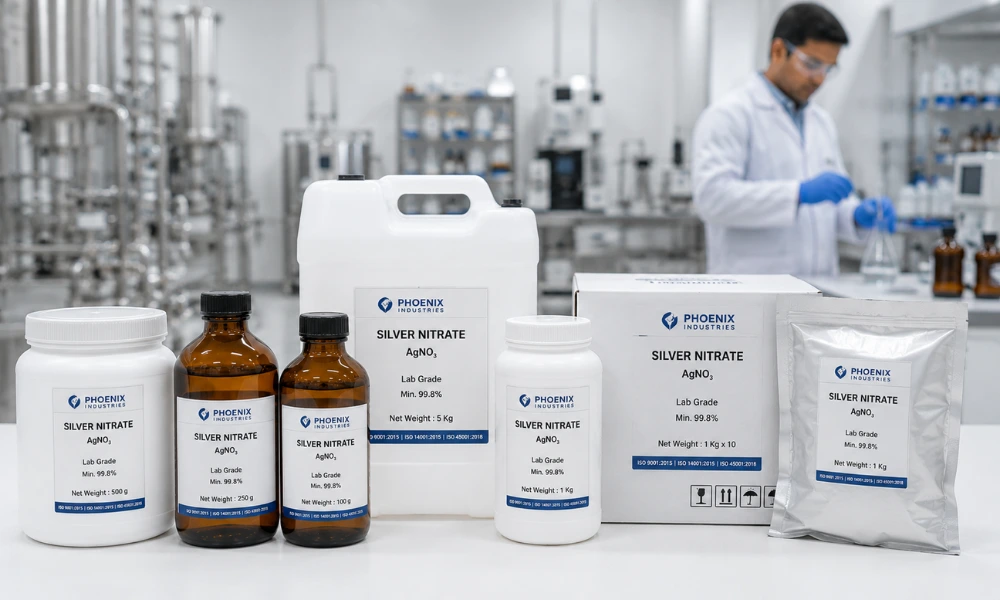
Why Electroplating Operations Choose Pheonix Industries
We manufacture silver nitrate at our facility in Ahmedabad. We’re not a trader — which means we have direct control over the production process, the QC testing, and the documentation that comes with every batch.
Every batch of silver nitrate we dispatch is tested using titration and gravimetric analysis before it leaves the facility. The Certificate of Analysis we provide is batch-specific — it reflects the actual test results for the material you receive, not a template with an assumed specification. If your quality team wants to verify the batch, the test data exists and we can share it.
We supply electroplating operations across India producing a range of finishes — from general decorative silver on jewellery and silverware, to functional silver deposits on electronics connectors and precision components. The grade requirements are different across these applications, and we manufacture to the grade your process needs.
On supply consistency: this matters for electroplating more than for some other chemical applications because bath chemistry is cumulative. A single batch that deviates from specification doesn’t just affect that plating run — it affects the bath going forward until it’s corrected or dumped. Consistency between batches is something we treat as a basic obligation, not a selling point.
If you want to evaluate whether our silver nitrate is right for your process, request a sample with the full COA. We’ll send both. If the specification matches what your process needs and the test results confirm it, the decision is straightforward. If it doesn’t match, we’ll tell you.
Frequently Asked Questions
Q. What concentration of silver nitrate is typically used in a silver plating bath?
Ans. For direct silver nitrate baths (cyanide-free systems), typical concentrations are 25–50 g/L of silver nitrate. The exact concentration depends on bath formulation, current density, and finish requirements. Higher concentrations support higher current densities but require tighter impurity control. For cyanide-based systems, silver nitrate is used to prepare silver cyanide rather than used directly in the bath.
Q. What purity of silver nitrate do I need for electroplating electronic components?
Ans. For electronic components — connectors, terminals, circuit boards, precision parts — electroplating grade (99.8–99.9%) with chloride ≤0.001% and copper ≤0.001% is the minimum appropriate specification. For high-specification components subject to third-party quality inspection or functional testing, AR grade (99.9%+) is recommended. Confirm your customer’s specification before choosing a grade.
Q. Can chloride impurities in silver nitrate really affect plating quality?
Ans. Yes, directly. Chloride reacts with silver ions to form silver chloride precipitate, which can deposit with the silver layer and create porosity. Even low-level chloride contamination — in the ppm range — causes measurable effects in sensitive applications. For electronics plating, chloride control in the silver nitrate input is not optional.
Q. How do I know if my bath problems are coming from the silver nitrate input?
Ans. Batch-specific COA documentation is the starting point. If your supplier provides test results for each batch and you retain records, you can correlate bath performance changes with batch changes. If your supplier only provides a generic specification sheet, you have no way to make this correlation. This is one practical reason why batch-specific documentation matters, independent of the quality claim itself.
Q. Is it worth paying more for higher-grade silver nitrate for decorative plating?
Ans. Honestly, not always. For purely decorative applications — jewellery, silverware, decorative hardware — where finish appearance is the only requirement and no functional testing applies, industrial grade silver nitrate is often sufficient. The key is matching the grade to the actual requirement, not defaulting to either the cheapest or the highest grade available.
Q. Does Pheonix Industries supply silver nitrate for both cyanide-based and cyanide-free plating systems?
Ans. Yes. Silver nitrate from Pheonix Industries is used in both cyanide-free direct baths and as the precursor compound for preparing silver cyanide in cyanide-based systems. The grade requirement is the same regardless of which system you’re running — what changes is the bath formulation, not the silver nitrate specification.
Getting the Input Right Is the Simplest Process Improvement Available
Most electroplating operations spend considerable time and money managing bath chemistry, optimising current density, and troubleshooting finish defects. The quality of the silver nitrate input can either support all of that work or undermine it. It’s the one variable that’s entirely in your control before the process begins.
Specifying the right grade for your application — not the cheapest and not unnecessarily expensive — and sourcing from a manufacturer who can provide batch-specific documentation is a straightforward decision. It doesn’t guarantee a perfect process, but it removes a real and common source of process problems.
Pheonix Industries manufactures silver nitrate in Ahmedabad in industrial, electroplating, and AR grades for operations across India. If you want to discuss grade selection for your specific application, request a sample with COA, or enquire about bulk supply terms, contact us directly.
Pheonix Industries — Silver Nitrate for Electroplating
Industrial, Electroplating & AR Grade. Batch COA with every order. Consistent supply across India.
Request a Sample + COA | Get Bulk Pricing | Discuss Grade Requirements
sales@pheonixindustries.com | +91-9824095459/60 | www.pheonixindustries.com