
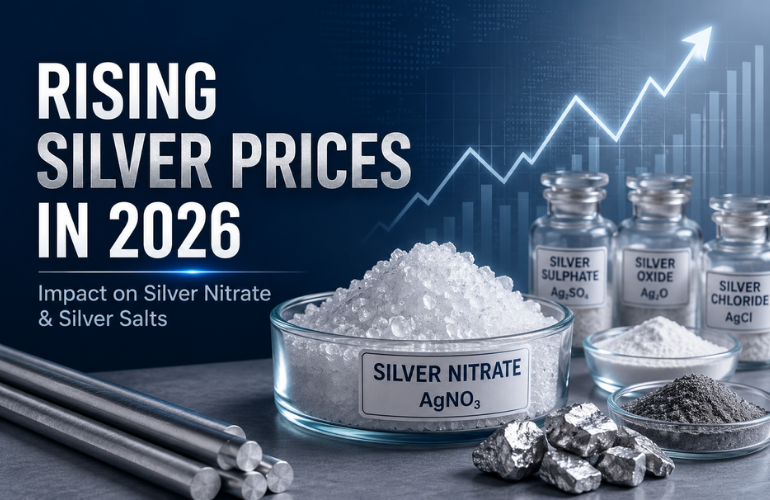
Silver has had an unusual couple of years. The metal reached record levels above $121 an ounce in January 2026 before falling sharply and continuing to experience significant volatility. Even after the correction, silver prices remain highly relevant to industrial buyers because the market is still affected by changing demand, supply conditions and wider economic factors.
For an investor, that kind of swing is a trading story. For an industrial buyer of Silver Nitrate, Silver Sulphate, Silver Oxide, Silver Metal Powder, or Silver Chloride, it’s something else entirely: a raw material cost that can move production budgets by a meaningful margin within a single quarter. If your procurement team hasn’t already started factoring silver-price volatility into purchase planning, this is a good time to start.
Why Rising Silver Prices Matter to Industrial Buyers
Silver is a key raw material in silver-based compounds and materials. The manufacturing cost of a finished product can depend on the underlying metal price, along with processing, purity, quality control, packaging, logistics and other commercial factors. When the underlying silver price moves sharply over a period of months, that movement can influence finished product pricing.
A few practical effects follow from this:
-
- Manufacturing costs can shift with the market.Products that rely on silver-based materials as process inputs may see raw-material costs change as silver prices move.
- Procurement budgets need more flexibility. Annual budgets based on a single assumed silver price can become less reliable during a volatile market.
- Bulk purchasing decisions carry more weight. For businesses with predictable consumption, reviewing order schedules and expected volumes can help improve budgeting and reduce exposure to sudden short-term price movements.
- Supplier relationships matter more, not less. A supplier who communicates product specifications, quotations and supply requirements clearly can be a valuable partner during volatile periods.
None of this means buyers should try to time the silver market like a trader. It means production planning, purchase timing, and supplier selection can benefit from treating silver price movement as a planning variable rather than a surprise.
How Rising Silver Prices Can Affect Silver Nitrate Buyers
Silver Nitrate (AgNO₃) is an important silver compound used across industrial and laboratory applications. Because silver is the core raw material used in its production, changes in the underlying silver market can significantly influence Silver Nitrate pricing. The final silver nitrate price in India, however, can also depend on purity, grade, processing, quantity, packaging and supplier terms.
This matters for buyers across several sectors. According to Pheonix Industries, Silver Nitrate is used in laboratory and analytical work, chemical manufacturing, silver plating, mirror production, photographic and imaging applications, and other specialised industrial processes. Buyers aren’t simply purchasing a chemical; they are purchasing a specific product specification that their process may depend on.
When silver prices climb, the temptation is to shop purely on silver nitrate price per kg in India. That approach can create problems if the lower-priced material does not match the application’s requirements. A few things are worth keeping in mind during a rising-price environment:
-
- Purity and grade still decide the outcome. Different applications may require different specifications, and buyers should confirm that the selected Silver Nitrate matches their process requirements.
- Batch consistency matters. Where production or laboratory processes depend on defined specifications, consistency between batches can be as important as the quoted price.
- Documentation supports verification. Pheonix Industries states that it provides a Certificate of Analysis and MSDS with every Silver Nitrate order. Buyers should confirm that available documentation meets their own quality and compliance requirements.
- Procurement planning can reduce surprises. Businesses with predictable consumption may benefit from discussing expected volumes and purchase schedules with their supplier.
For buyers comparing silver nitrate manufacturers in India, the goal should not be to predict the exact direction of the silver market. It is to understand the product requirement clearly and make purchasing decisions based on price, specification, quality requirements and expected consumption.
What Rising Silver Prices Mean for Other Silver-Based Materials
The impact of silver price movements is not limited to Silver Nitrate. Pheonix Industries also manufactures and supplies Silver Metal Powder, Silver Oxide, Silver Sulphate and Silver Chloride. However, a rise in the silver metal price does not automatically translate into an identical percentage increase across all five products. Silver content, processing requirements, product specifications and other costs can differ.
Silver Metal Powder
Silver Metal Powder is used in a range of industrial applications. Pheonix Industries identifies electronics, conductive inks, pastes and high-performance circuit components among its applications. Its electrical conductivity makes it relevant to silver metal powder for electronics and conductive material applications. Buyers should consider purity, particle characteristics and suitability for the intended process alongside market price.
Silver Oxide
Silver Oxide has specialised uses in areas including certain battery and chemical applications. Pheonix Industries also identifies pharmaceutical and healthcare applications for its silver-based products. Product specifications can vary depending on the intended use, so buyers should compare technical suitability rather than treating all silver-based materials as interchangeable.
Silver Sulphate
Silver Sulphate is used in analytical chemistry, laboratory work and specialised chemical applications. Pheonix Industries also identifies silver plating and complex chemical synthesis among its listed uses. For these applications, product quality and suitability for the required process can be important purchasing considerations.
Silver Chloride
Silver Chloride is used in applications including electroplating, laboratory work and photographic applications, according to Pheonix Industries. As with other silver compounds, buyers should review the required product specification rather than assuming that a lower price represents the same level of suitability for their application.
What Industrial Buyers Should Consider Beyond Price
Price per kilogram is the number that shows up on a quotation, but it does not provide the complete picture. A few factors are worth weighing alongside price, particularly when the market is volatile:
-
- Purity and grade fit for the application– different grades and specifications suit different processes, so buyers should confirm what their operation requires.
- Batch consistency– particularly where a process depends on stable material specifications.
- Certificate of Analysis and MSDS documentation– buyers can confirm which documents are needed for their internal quality, safety and compliance requirements.
- Packaging suited to storage and handling– especially where a product has specific storage requirements.
- Supply reliability– particularly if production depends on regular material availability.
- Ability to handle bulk requirements– based on expected volume and agreed supply terms.
- Supplier understanding of the application– a supplier familiar with the product’s industrial use may be better positioned to answer specification-related questions.
None of these factors replace price as a consideration. They sit alongside it and help buyers evaluate whether a quoted product meets the technical and commercial requirements of the purchase.
Choosing the Right Silver Salt Manufacturer or Supplier
A volatile silver market makes supplier selection an important part of procurement planning. A few practical questions worth asking before committing to a new supplier or renewing an existing relationship:
-
- Does the supplier clearly provide product specifications and technical information?
- Does the supplier provide relevant documentation, such as a Certificate of Analysis or MSDS, where required?
- Can the supplier support your expected volume and supply requirements?
- Does the supplier offer the specific grade or specification your process needs?
- Does the product and packaging match your intended application, storage and handling requirements?
Pheonix Industries has been manufacturing Silver Nitrate, Silver Sulphate, Silver Oxide, Silver Metal Powder and Silver Chloride from Ahmedabad, Gujarat, since 2006. The company states that its manufacturing process includes R&D, pilot-scale testing, quality inspection and analytical testing, and that it supplies relevant documentation with its products. These are useful factors for buyers to consider when evaluating a silver salt manufacturer in India alongside other suppliers.
For buyers reassessing their silver-salt supply chain during a period of price volatility, product specifications, documented quality checks, available grades and supply capability can provide a more useful basis for evaluation than price alone.
What Could Silver Demand Mean for Industrial Buyers in 2026?
The 2026 silver market is more complex than a simple story of industrial demand rising across every sector.
The Silver Institute expects the global silver market to remain in deficit for a sixth consecutive year. At the same time, its 2026 outlook forecasts a decline in industrial fabrication, with high prices encouraging thrifting and substitution in some applications, particularly in the photovoltaic sector. This means industrial demand conditions are not moving in the same direction across every use of silver.
Even so, silver remains important to a range of industries. Electronics and electrical applications continue to be significant demand areas, while technologies linked to AI, data centres, automotive applications and other advanced electrical uses remain important longer-term drivers. Higher silver prices, however, can increase pressure on manufacturers to reduce silver use or seek alternatives where technically possible.
On the supply side, the Silver Institute continues to forecast a market deficit in 2026. For industrial buyers, the practical takeaway is not that every silver-based product will follow the same price path. Silver content, processing requirements, product specifications and supply conditions can all affect the final quotation.
For buyers of Silver Nitrate specifically, this means continued attention to product-specific pricing and procurement requirements. For Silver Metal Powder buyers, electronics and conductive applications may be more relevant to their purchasing decisions. Buyers don’t need to track daily spot prices to make good decisions, but staying aware of broader market conditions can help when reviewing budgets and planning future requirements.
Conclusion
Silver’s price swings have moved from a financial-market headline to a genuine planning consideration for industrial buyers. Silver Nitrate, because silver is its core raw material, deserves particular attention in procurement planning- not just at the point of purchase, but when reviewing grade, specification, consistency and supply requirements.
The other silver-based materials in an industrial buyer’s purchasing list, from Silver Metal Powder to Silver Oxide, Silver Sulphate and Silver Chloride, each have their own product characteristics, price sensitivity and application requirements. Treating them as identical is not accurate.
Prices may continue to move. What buyers can control is how well they plan around changing conditions by reviewing their requirements clearly and working with suppliers who can provide appropriate specifications, documentation and supply information.
If your team is reassessing silver salt suppliers in India for the year ahead, Pheonix Industries can discuss current specifications, documentation and bulk supply requirements for Silver Nitrate, Silver Sulphate, Silver Oxide, Silver Metal Powder and Silver Chloride. Contact Pheonix Industries
Frequently Asked Questions
Q. Why are silver prices rising in 2026?
Ans. Silver prices in 2026 have been influenced by a combination of investment demand, supply conditions, economic factors and industrial demand. The Silver Institute expects the market to remain in deficit for a sixth consecutive year, although industrial demand is expected to vary across different sectors.
Q. How do rising silver prices affect Silver Nitrate prices?
Ans. Silver is the core raw material used to manufacture Silver Nitrate, so changes in the underlying silver market can influence its cost. The final price can also depend on purity, grade, processing, order quantity, packaging and supplier terms.
Q. Why is Silver Nitrate important for industrial applications?
Ans. Silver Nitrate is used in applications including laboratory and analytical work, chemical manufacturing, electroplating, photography and imaging, and mirror production, depending on the required product specification.
Q. What factors should industrial buyers consider when purchasing Silver Nitrate?
Ans. Beyond price per kilogram, buyers should evaluate the required purity and grade, application suitability, batch consistency, available Certificate of Analysis and MSDS documentation, packaging and expected supply requirements.
Q. How do silver prices affect other silver salts?
Ans. Silver price movements can influence the cost of Silver Metal Powder, Silver Oxide, Silver Sulphate and Silver Chloride, but not necessarily by the same percentage. Silver content, processing complexity and product specifications can differ.
Q. What should buyers look for in a silver salt manufacturer in India?
Ans. Buyers should review product specifications, available documentation, application suitability, required grade, packaging and the supplier’s ability to meet expected volume requirements. The right choice depends on both technical and commercial needs.
Q. How is Silver Metal Powder used in industrial applications?
Silver Metal Powder is used in applications where silver’s electrical conductivity and other material properties are required. Pheonix Industries identifies electronics, conductive inks, pastes and high-performance circuit components among its applications.
Q. Why does Silver Nitrate purity matter for industrial applications?
Different processes may require specific purity levels and grades. Buyers should confirm that the Silver Nitrate specification matches the requirements of their application and review the relevant product documentation before purchase.