
In the demanding landscape of industrial manufacturing and scientific research, the margin for error is virtually zero. Silver salt in chemistry serves as a cornerstone for countless reactions, yet it remains one of the most sensitive materials to handle. Many procurement heads and lab managers in India face a recurring set of hurdles that compromise their output.
The struggle often begins with inconsistent purity levels that ruin expensive batches or lead to failed laboratory tests. Selecting the wrong type of silver salt for a specific reaction can result in yield loss, safety hazards, or product contamination. Furthermore, the lack of a reliable, chemistry-focused supplier in the domestic market often leads to supply chain gaps that stall production. Understanding the diverse types of silver salt in chemistry is not just an academic exercise; it is a prerequisite for maintaining operational safety, accuracy, and cost control in a competitive market.
At Pheonix Industries, we bridge the gap between complex chemical requirements and industrial-scale supply, ensuring that every crystal of silver salt we manufacture meets the highest standards of the trade.
Challenges Faced in Industrial and Laboratory Use of Silver Salts
Relying on sub-par silver salts introduces a cascade of technical and financial problems. In a laboratory setting, even a trace amount of an impurity can shift the results of a sensitive titration or qualitative analysis, leading to unreliable data. For industrial chemical manufacturers, low-purity salts often mean lower reaction yields, which directly hits profitability.
The selection process itself is a challenge. Using silver salt in chemistry examples like Silver Nitrate when an insoluble variant like Silver Chloride is required can lead to catastrophic process failures. Beyond the chemistry, there are regulatory and compliance hurdles. Indian industries must adhere to strict quality and safety standards, and using materials from unverified sources puts these certifications at risk. Handling these salts also requires specialized knowledge of their light-sensitivity and reactivity—factors that, if overlooked, create significant safety risks for personnel.
What Are Silver Salts in Chemistry and Why Are They Important?
A silver salt in chemistry is a compound where silver ions ($Ag^+$) are bonded with an acid radical. These compounds are prized for their unique ability to participate in electron transfer, their predictable reactivity with halides, and their varying degrees of solubility.
Silver ions act as powerful oxidizing agents and catalysts. This makes silver salts indispensable in analytical and inorganic chemistry. Generally, these salts are classified into two categories:
- Soluble Silver Salts: Such as Silver Nitrate, which dissolve easily in water and are used when free silver ions are needed in a solution.
- Insoluble Silver Salts: Such as Silver Chloride, which are used in solid-state applications or as precipitates.
The importance of these salts lies in their consistency. In chemistry, the behavior of the particle—its size, stability, and purity—determines the success of the final product, whether it is a life-saving drug or a high-performance electronic component.
Uses of Silver Salts in Chemistry for Laboratory Applications
Laboratories across India utilize various silver salts for high-precision tasks. The choice of salt depends entirely on the intended analytical or research goal.
- Analytical Chemistry: Silver salts are the gold standard for detecting halides (chloride, bromide, and iodide). Through precipitation reactions, researchers can identify and quantify these elements with high accuracy.
- Titration & Standardization: Silver Nitrate is frequently used in argentometric titrations to determine the concentration of salt in various samples.
- Electrochemical Studies: Silver Chloride is essential in creating reference electrodes, providing a stable potential for measuring chemical reactions.
- R&D and Chemical Imaging: Due to their light-sensitive nature, specific silver salts are used in research involving photochemical reactions and advanced imaging techniques.
- Academic Use: In educational labs, these salts demonstrate fundamental principles of inorganic chemistry, such as displacement and precipitation.
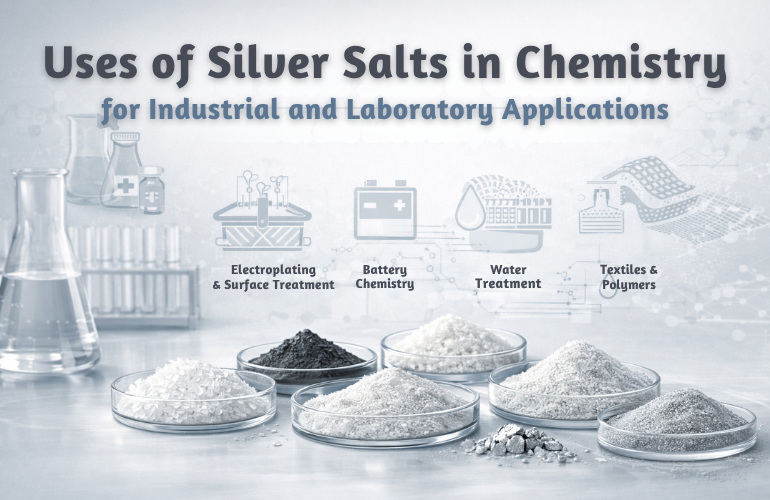
Uses of Silver Salts in Chemistry for Industrial Applications
On an industrial scale, the application of silver salt in chemistry shifts toward scalability and process stability.
- Pharmaceutical Chemistry: Silver salts serve as catalysts in the synthesis of complex organic molecules and act as precursors for active pharmaceutical ingredients (APIs).
- Electroplating & Surface Treatment: High-purity silver salts provide the silver ions necessary for plating conductive layers on metals, essential for the electronics and jewelry sectors.
- Battery Chemistry: As India moves toward advanced energy storage, silver-based salts are being utilized in high-energy-density battery systems and electrochemical cells.
- Water Treatment: Silver’s natural antimicrobial properties make its salts valuable in specialty water purification systems where high-level sterilization is required.
- Textiles & Polymers: Silver salts are integrated into polymers to create antimicrobial coatings for medical textiles and high-end consumer goods.
Types of Silver Salts Used in Chemistry and Their Specific Uses
-
Silver Nitrate in Chemistry
Silver Nitrate ($AgNO_3$) is arguably the most recognized silver salt in chemistry example. It is highly soluble in water, making it the perfect precursor for synthesizing other silver compounds. Its primary role is as a reagent in analytical chemistry and as a catalyst in industrial-scale pharma synthesis.
-
Silver Chloride in Chemistry
Unlike the nitrate form, Silver Chloride ($AgCl$) is famous for its insolubility. This characteristic is precisely why it is used in reference electrodes and certain types of glass manufacturing. Its extreme sensitivity to light also makes it a staple in the production of specialized sensors.
-
Silver Oxide in Chemistry
Silver Oxide ($Ag_2O$) is frequently used in oxidation reactions within organic chemistry. In the industrial world, it is a key component in the production of silver-zinc batteries and as a purifying agent in various chemical processes.
-
Silver Sulphate in Chemistry
Silver Sulphate ($Ag_2SO_4$) offers controlled solubility. It is primarily used in environmental testing, specifically for the analysis of Chemical Oxygen Demand (COD) in wastewater, helping industries stay compliant with environmental regulations.
Why High-Purity Silver Salts Matter in Chemical Applications
The difference between a successful industrial batch and a total loss often comes down to the grade of the salt used. Industrial-grade salts might suffice for basic plating, but laboratory-grade purity is mandatory for R&D and pharmaceutical synthesis.
Using low-quality materials can lead to “side reactions,” where impurities interfere with the desired outcome, leading to poor reproducibility. For a business in India, this isn’t just a technical flaw—it’s a financial drain. High-purity salts ensure that every reaction is predictable, every batch is identical, and every laboratory result is beyond reproach.
Why Choose Pheonix Industries for Silver Salts in Chemistry
Pheonix Industries understands that we aren’t just selling a chemical; we are providing the foundation for your business’s technical success. Our manufacturing process is driven by chemistry and refined by years of industrial experience.
- Unmatched Purity: We provide batch-to-batch reliability that laboratories and chemical plants can trust.
- Comprehensive Range: From the highly soluble Silver Nitrate to the specialized Silver Sulphate, we cover the full spectrum of your needs.
- Indian Market Expertise: We specialize in supporting Indian R&D institutions and manufacturers with bulk supply chains that are both reliable and compliant.
- Authoritative Standards: Our products are manufactured under strict quality controls, ensuring they meet the rigorous demands of modern chemical manufacturing.
Frequently Asked Questions on Silver Salts in Chemistry
1. What are silver salts used for in chemistry?
Ans. They are used for halide detection, as catalysts in pharmaceutical synthesis, in electroplating, and as essential components in electrochemical cells and batteries.
2. Which silver salt is commonly used in laboratories?
Ans. Silver Nitrate is the most common due to its high solubility and versatility as a reagent.
3. Which silver salts are soluble in water?
Ans. Silver Nitrate is highly soluble, whereas Silver Sulphate has limited solubility.
4. Which silver salt is insoluble in water?
Ans. Silver Chloride and Silver Oxide are primarily insoluble in water.
5. Why is silver nitrate widely used in chemistry?
Ans. It is the most economical and soluble source of silver ions, making it an ideal precursor for almost all other silver-based chemical reactions.
6. Are silver salts safe to handle in laboratories?
Ans. They are safe when handled with proper PPE (gloves and goggles). Silver Nitrate, in particular, can cause skin staining and is an oxidizer, so it must be stored away from organic materials.
Conclusion
Choosing the right silver salt in chemistry is a decision that impacts your accuracy, safety, and bottom line. Whether you are conducting high-level research in a laboratory or managing a large-scale chemical manufacturing plant in India, the purity and reliability of your supplier are paramount.
Don’t let inconsistent materials compromise your professional standards. Connect with Pheonix Industries today to source high-purity silver salts designed for precise chemical applications and industrial excellence.