
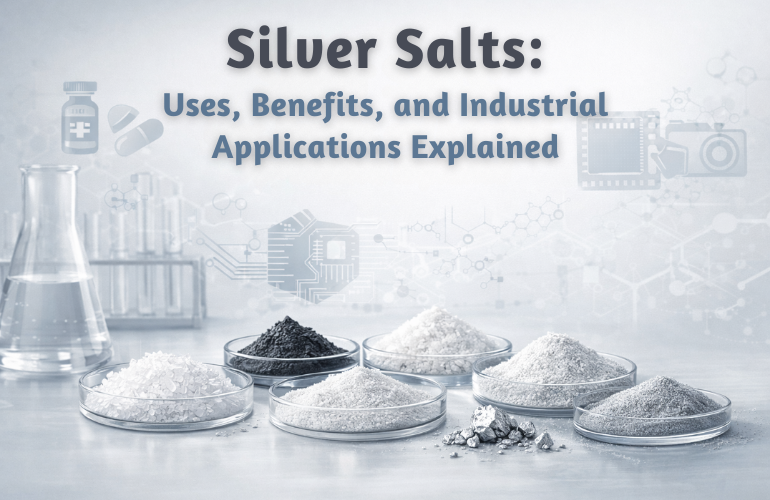
Silver Salts: Uses, Benefits, and Industrial Applications Explained
In the world of industrial chemistry, silver is far more than a precious metal used in jewelry. When silver chemically bonds with other elements, it forms a group of compounds known as silver salts. These substances—ranging from highly reactive silver nitrate to light-sensitive silver chloride—serve as the invisible backbone of modern manufacturing.
As industries move toward higher precision, advanced technology, and sustainable processes, the demand for high-purity silver compounds continues to grow across global manufacturing hubs. For decision-makers and procurement professionals, understanding specific silver salts uses is essential. Whether ensuring the conductivity of a solar panel or maintaining the sterility of a medical device, selecting the right silver compound directly influences product quality, safety, and performance.
What Are Silver Salts and Why Do They Matter in Industry
Silver salts are chemical compounds formed when silver (Ag) reacts with acids or halogens. Their industrial importance comes from their ability to release silver ions (Ag⁺), which drive many of their functional properties.
Key Industrial Properties
- Antimicrobial Activity:
Silver ions disrupt bacterial cell walls and metabolic functions, making silver salts essential in sterile manufacturing environments. - Electrical Conductivity:
Silver possesses the highest electrical conductivity of all metals, and this property carries over into its salts, supporting applications such as conductive inks and battery components. - Light Sensitivity:
Certain silver halides react instantly when exposed to light, a property that remains critical for industrial radiography and specialty coating applications. - Chemical Reactivity:
Silver salts act as powerful oxidizing agents and catalysts, enabling complex reactions in organic synthesis and industrial chemistry. - Solubility Behavior:
Solubility plays a key role in industrial selection. - Which silver salts are soluble in water? Silver nitrate and silver sulphate are the primary water-soluble salts used in aqueous reactions.
- Which silver salt is insoluble in water? Silver chloride and silver oxide are insoluble, making them suitable for solid-state applications and protective coatings.
Industrial Applications of Silver Salts Across Key Sectors
The industrial application of silver salts depends on their chemical behaviour and physical form. Each salt is chosen to meet specific sector requirements.
-
Chemical and Pharmaceutical Manufacturing
The pharmaceutical industry depends on the purity of silver nitrate for synthesis processes. It functions as a catalyst in drug manufacturing and as an antiseptic in medicinal formulations. In broader chemical manufacturing, silver salts are used in mirror production through the silvering process and as precursors for specialty silver compounds.
Best Choice: Silver Nitrate for its solubility and high reactivity.
-
Healthcare and Medical Devices
Silver chloride and silver nitrate are widely used for antimicrobial protection. Modern wound dressings incorporate silver salts to reduce infection risks, while catheters and surgical implants are coated with silver chloride to prevent biofilm formation.
Best Choice: Silver Chloride for controlled, long-term silver ion release.
-
Electronics, Electrical Components, and Battery Manufacturing
The electronics sector relies heavily on silver metal powder and silver oxide. Silver metal powder is used for conductive tracks on printed circuit boards (PCBs), while silver oxide serves as the cathode material in high-energy-density button cell batteries used in medical and aerospace devices.
Best Choice: Silver Metal Powder for conductivity; Silver Oxide for energy storage.
-
Renewable Energy (Solar and Photovoltaics)
In solar manufacturing, silver metal powder is essential for forming conductive grids on silicon solar cells. These powders are used in metallization pastes that efficiently capture and transfer electrical energy generated from sunlight.
Best Choice: Silver Metal Powder with controlled particle size for optimal sintering.
-
Water Treatment and Sanitation
Silver salts provide an effective alternative to chlorine-based disinfectants. Silver nitrate and silver sulphate are used in industrial cooling systems and large-scale water purification to control microbial growth without altering taste or odor.
Best Choice: Silver Sulphate for balanced antimicrobial performance and stability.
-
Photography and Specialty Coatings
Despite the rise of digital imaging, industrial radiography still depends on silver halides. For those asking which silver salt is used for making film of photography, the answer is silver chloride. When exposed to radiation and developed, it forms metallic silver, explaining which salt of silver is black in colour after exposure.
Best Choice: Silver Chloride for precise photosensitivity.
Benefits of Using High-Purity Silver Salts in Manufacturing
Using high-purity silver salts (99.9% or higher) delivers measurable advantages over lower-grade materials.
- Consistent Antimicrobial Performance: Pure salts release silver ions at predictable rates, ensuring reliable antimicrobial activity in medical and textile applications.
- Superior Conductivity and Sintering: In electronics, even trace impurities can cause circuit failure. High-purity silver metal powder ensures optimal electrical flow and strong adhesion during sintering.
- Predictable Chemical Reactions: In laboratory and pharmaceutical synthesis, purity eliminates unwanted side reactions. This is why which silver salt has white colouration, specifically pure silver chloride, is used as a visual indicator of a clean chemical reaction.
- Environmental and Economic Efficiency: High-purity compounds perform effectively at lower concentrations, reducing material usage, waste, and long-term costs.
Choosing the Right Silver Salt Manufacturer for Industrial Needs
For industries operating across manufacturing clusters in India and global markets, supply reliability is as critical as chemical quality. A silver salt manufacturer must act as a technical partner, not just a supplier.
-
Strict Quality Standards and Consistency
A professional manufacturer like Pheonix Industries ensures every batch meets strict specifications for purity, particle size, and solubility. Even small variations in silver oxide composition can impact battery performance. Pheonix Industries’ manufacturing facilities in Ahmedabad, Gujarat, are designed to meet global quality benchmarks.
-
Reliable Supply Chains and Bulk Availability
Industrial buyers require uninterrupted supply. Pheonix Industries maintains strong inventory control and efficient logistics to support bulk orders of silver nitrate, silver metal powder, and other silver salts without production delays.
Why Choose Pheonix Industries
- Expertise: Over 15 years of specialization in silver-based chemistry
- Quality: Certified 99.9% purity across all silver salt products
- Support: Technical guidance to select the right silver salt for applications in pharma, electronics, electroplating, and solar energy
Conclusion
The strategic use of silver salts is fundamental to modern industrial progress. From the antimicrobial strength of silver chloride in healthcare to the energy efficiency enabled by silver metal powder in solar panels, these compounds drive innovation across sectors.
If your business requires a dependable supply of silver nitrate, silver sulphate, silver oxide, or silver chloride, Pheonix Industries is a trusted partner. Connect with us today for a detailed quote or a technical discussion on how our high-purity silver salts can enhance your manufacturing performance.
Frequently Asked Questions: Industrial Silver Salts
Q: What are silver salts used for in industrial manufacturing?
Ans. Silver salts are used in electronics for conductive pastes, in pharmaceuticals for antimicrobial coatings, in photography for light-sensitive imaging, and in renewable energy for solar panel metallization. They also function as catalysts and analytical reagents in chemical processing.
Q: Which silver salt is used for making film of photography?
Ans. Silver chloride and silver bromide are the primary salts used in photographic emulsions due to their high light sensitivity.
Q: Which silver salts are soluble in water?
Ans. Silver nitrate is fully soluble in water, while silver sulphate is moderately soluble and commonly used in laboratory and environmental testing.
Q: Which silver salt is insoluble in water?
Ans. Silver chloride and silver oxide are insoluble in water, making them suitable for coatings, electrodes, and battery applications.
Q: Which salt of silver is black in colour?
Ans. Silver oxide appears as a black or dark brown powder. Additionally, exposed and developed silver halides form metallic silver, which also appears black.
Q: Which silver salt has white colouration?
Ans. Silver chloride is known for its white crystalline appearance and is widely used in analytical chemistry.
Q: Why is purity critical when choosing a silver salt manufacturer in India?
Ans. High-purity silver salts ensure consistent performance in sensitive applications such as electronics and pharmaceuticals. Manufacturers like Phoenix Industries apply strict quality control and advanced R&D to meet these demands.